The Employment of AI in Mathematics, Adonai Sant'Anna
Original, in Portuguese, at O Emprego de IA em Matemática. Adonai Sant’Anna is a mathematics professor at the Federal University of Paraná (UFPR).
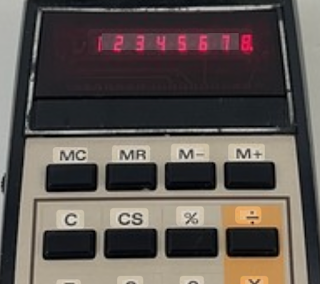
In the late 1970s I took an electronic calculator to the school where I studied. It was a simple machine with a red incandescent display that operated on a nine-volt battery and performed additions, subtractions, multiplications, and divisions. I showed a colleague some trivial accounts with the device and he immediately replied: smart little machine, right! I was immediately discouraged by the reaction. I kept the calculator and didn’t show it to anyone else at school.
Nowadays, the hot topic is Artificial Intelligence (AI), a new machine that causes astonishment among impressionables devoid of any reference to what intelligence is. Several open math problems are being solved with the help of AI. From cases like these there is a ridiculously exaggerated fuss about the eventual replacement of humans by machines to do research in mathematics. The purpose of this post is to inform something trivial but that needs to be said especially to young people who still dream of making significant contributions to mathematics.
In short, this post states the following:
Mathematics research is changing thanks to the use of AI;
Relevant development in mathematics is unfeasible without humans.
First, current AI models (LLMs) emerged thanks to the introduction of the Transformer architecture in a 15-page paper written by eight computer scientists and software engineers. The mathematics behind this impactful contribution are linear algebra (to simultaneously process billions of parameters), differential and integral calculus (for adjusting weights in neural networks, which minimize prediction errors), and probabilities and statistics (for quantifying uncertainty and making predictions). When an AI is “thinking,” it is simply performing operations between vectors and matrices. Such operations receive as input information that is already somehow available in databases or even on the internet.
In other words, all AI is the result of applying mathematics conceived and developed by humans. This mathematics, as always occurs, has its own limitations. There are things that can be done with linear algebra and there are those that cannot be done. It is precisely the linear algebra of all AI that allows us to focus attention, for example, on the word ‘bank’ in sentences like “the bank in the square is broken” and “the bank was robbed during the morning.” The Transformer architecture assigns a higher attention value to the word square in the case of the first sentence. But it assigns a higher score to the word robbed in the case of the second sentence. In this way, the AI can maintain a seemingly coherent dialogue with the user based on these scores. However, no AI “knows” what a bank is in either situation. AI works with weights assigned to words according to an internal processing architecture. Nothing more than that. AIs do not operate with semantics. Nothing an AI reads or sees or hears has meaning in the usual sense of natural language semantics. No AI sat on a square bench. No AI robbed a bank or witnessed a bank robbery. Because of this, AIs are devoid of a sense of humor. An AI can tell jokes that make users laugh. But an AI is absolutely naive when it itself is the target of a joke made by humans. Do the experiment! Tell an AI of your choice the following sentence: “the park bench has been robbed.” Will any AI have the sense of humor to imagine a park bench raising its arms in front of an armed robber? Cartoonists are obviously smarter than AIs when it comes to humor.
Certain AIs have been used to solve open mathematical problems for decades. What does this tell us?
There are literally thousands of open math problems. Some mathematicians try to solve them. Others propose new problems and try to solve them. Others investigate new ways to solve already solved problems simply because they don’t like unnecessarily complicated solutions. Others prefer to create new theories and investigate them with the purpose of understanding mathematics from other points of view. Others prefer to simply apply well-known mathematical tools to deal with technological, logistical, financial, military, social, and other problems. Incidentally, this was the case with the Transformer architecture. Still others are concerned with philosophical questions of mathematics. Others prefer to focus on historical aspects. Others prefer to investigate mathematics teaching techniques. Ultimately, the fact that a mathematical problem has been open for a long time in no way reflects any intellectual barrier that prevents humans from solving such a question today. There is much more work to be done in mathematics than there is manpower dedicated to all that work.
If an AI can solve a long-standing problem, that’s excellent news. One less problem after all. But it is a problem whose solution employs only what is already known about mathematics.
What can’t an AI do in terms of math research? Here is a brief list:
Create new theories that illuminate mathematical activity by surprisingly connecting different areas of knowledge. For example, category theory allows us to connect branches of mathematical analysis with branches of algebra. This is something an AI would not be able to do from its current architecture. After all, theory-making demands creativity. There is no creativity in any AI. Another example: the concept of vector space made current AI viable. What new theories of mathematics can enable new forms of AI without the current barriers of AI itself? An AI will never answer this question in the slightest bit creatively and relevantly.
Discern what is relevant from what is not. The judgment of mathematical relevance depends on technological, philosophical, pedagogical, historical, logistical and even mathematical factors, among others. AIs do not rely on autonomous judgments.
Self-criticism. AIs are devoid of self-criticism. Once an AI presents a very long demonstration of a theorem, it is subject to making errors of a logical and even conceptual nature without ’noticing’ it. This is due to the computational architecture that minimizes errors but can never zero them out. If there is no human judgment, there is no way to guarantee that a demonstration proposal is correct. AIs focus on speed of processing large volumes of information. AIs cannot “think” critically about this information.
Discern the beautiful from the inelegant. The way Maxwell’s equations were originally conceived is aesthetically inelegant. Oliver Heaviside managed to rewrite Maxwell’s same ideas into just four vector equations, revealing beauty and simplicity. AIs are not capable of contemplation on beauty.
What is the real contribution of AI in mathematics? The answer is obvious: to streamline research and allow more time for humans to reflect on what is truly important in mathematical activity.
AI is just a calculator on steroids. Just as electronic calculators were and are extremely useful, so is AI. But humans are far smarter than any machine they created. While a large data center consumes somewhere between ten megawatts and one hundred megawatts of power, a human brain consumes a mere twenty watts and does much more. A human brain consumes the same energy needed to light an economical LED light bulb. Nothing moderate doses of glucose and oxygen won’t fix.
Naturally, there is another, much more serious problem caused by the use of AI in mathematics: the future of the scientific publishing market. A new wave of submissions of mathematics papers is emerging in specialized journals. Editors will have to deal with it. But mathematics is an activity that transcends institutions. Editors will likely need more glucose and oxygen than mathematicians to deal with this issue
RSS #
O link RSS deste blog é https://adolfoneto.elixiremfoco.com/blog/feed.xml. Se quiser receber posts novos, assine!
Grupo no Signal para discutir críticas à Inteligência Artificial #
Feedback e ajuda #
Quer comentar? Manda um e-mail para adolfo @ utfpr.edu.br ou me manda mensagem no Bluesky.
Sou coordenador da Rede Emílias de Podcasts
Quer ajudar os podcasts ou me ajudar a ir a eventos?
Recursos #
- Devemos usar IA em tudo?
- The AI Con, livro de Emily M. Bender e Alex Hanna
- Newsletter da Felienne
- Pivot to AI - site e podcast de David Gerard
- Página da Olivia Guest
Comente no Bluesky #
The Employment of AI in Mathematics, Adonai Sant'Anna
adolfoneto.elixiremfoco.com/blog/posts/2…
— Adolfo Neto (@adolfoneto.elixiremfoco.com) August 25, 2026 at 9:13 AM
[image or embed]